Reverb is what makes a dry track sound alive. With so many plugins out there, picking one is hard, so here’s your yearly guide to the 11 best reverb plugins of 2026. Let’s get into it.
Ever notice how your voice sounds better in the bathroom? That’s reverb. The walls bounce your sound back, and suddenly it feels bigger and more alive. It’s the same thing that makes a dry track sound like it has a real room around it. You add some reverb and the whole thing opens up. Then you add a little more, and a little more, and suddenly the mix is soup.
So you go looking for a better reverb plugin, and that’s where it gets harder. There are hundreds of them. Every product promises “lush, “realistic,” or the last reverb you’ll ever need. But the truth is, technology changes, and in the era of AI, you cannot rely on just any plugin.
That’s why we put this guide together. Below are the Best 11 reverb plugins for 2026, from famous standards such as Valhalla Room to underrated picks like BB Chamber D, from free to pro. For each one, you’ll see what it does, what it costs, and who it suits, so you can choose without opening 40 tabs.
But first, let’s understand what reverb is and how it will help you to make your tracks alive.
Reverb 101 for beginners:
Reverb is the sound of reflections. When you make a sound in a room, it hits the walls, floor, and ceiling and bounces back thousands of times. Your ear blends those bounces into one impression of space: small, huge, hard, soft, close, far.
Every reverb plugin gives you some version of these controls:
- Decay (RT60): how long the tail lasts. Short for tight rooms, long for halls and cathedrals.
- Pre-delay: the gap between the dry sound and the first reflection. A little keeps vocals clear of the wash.
- Early reflections vs late tail: the first few bounces tell your ear how big the room is. The dense tail afterward is the “wash.”
- Damping and EQ: how the highs and lows die out. Real rooms lose treble faster than bass.
- Mix or send level: how much reverb you hear against the dry signal.
The main spaces you’ll see in presets:
- Room: small and natural. It adds life without being obvious.
- Hall: big and smooth, good for strings, pads, and ballads.
- Plate: a sheet of metal vibrated by a driver. Bright, dense, and a classic on vocals and snare.
- Chamber: a real reverberant room with a speaker and microphones in it. Smooth and musical.
- Spring: the twangy sound in guitar amps.
Here’re the 11 Best Reverb Plugins of 2026:
| Plugins | Best For |
|---|---|
| FabFilter Pro-R 2 | Precise, surgical mixing and immersive work |
| Waves Renaissance Reverb | Gluing a mix together with a classic-style algorithmic reverb |
| Eventide Blackhole | Ambient, sound design, spaces that can’t exist |
| Soundtoys SuperPlate | Vocals and snare with five classic plates |
| Kit Plugins BB Chamber D | A real chamber sound on vocals and leads |
| United Plugins Hyperspace | Building your own reverb character |
| Softube Dimensions | One plugin for spring, plate, room, hall, and shimmer |
| Baby Audio Crystalline | Lush, modern, tempo-synced reverb |
| UAD Lexicon 224 Digital Reverb | The classic 1980s digital reverb sound |
| Valhalla Room | Legendary reverb plugin for drums, vocals & acoustics |
| TAL-Reverb-2 (FREE) | A free, smooth plate reverb with retro effects |
Explore latest deal on VST Plugins here!
1. FabFilter Pro-R 2:
Pro-R by FabFilter is one of the most used reverb plugins among music producers. It has a six-band Decay Rate EQ for frequency-dependent decay shaping, plus a six-band post EQ. In practice, you can keep the low end tight and let the highs hang, which stops reverb from turning a mix into mud. The second version added two new algorithms, impulse response import, a Freeze button, an Auto Gate with tempo sync, and immersive support up to 9.1.6 channel layouts. Used by numerous producers and mixing engineers around the world, this is one of the best reverbs you can include in your plugin library.
Keep in mind: it’s more than a beginner needs.
Also Read: 7 AI Plugins That Will Actually Make You a Better Producer in 2026
2. Waves Renaissance Reverb:
Waves Renaissance Reverb is an algorithmic reverb with 12 reverb types, an advanced early reflection system, and dual-band EQ and damping controls. The types cover halls, chambers, plates, and other variations, and one handy detail is that a negative pre-delay value delays the dry signal. It comes with 265 presets from award-winning mix engineers, so you can pick one, adjust a few familiar knobs, and move on.
It suits beginners who want an easy start and mixers who like a familiar algorithmic sound, as well as the pros who want to enhance their production quality. You’ll need a Waves account and the Waves Central app to install it.
Get 50% off on Soundtoys Little AlterBoy: Click here!
3. Eventide Blackhole:
Eventide Blackhole earns its place on this list because it builds virtual spaces that could never exist in a real room. It began as an algorithm in Eventide’s DSP4000 and H8000FW hardware, where studio engineers treated it as a secret weapon for decades. The plugin is easy to use, with over 50 presets, and a gravity control that reverses the reverb’s decay, a Kill Switch that mutes the input so you hear only the reverb, and a Mix Lock that holds your wet/dry balance steady while you scroll through presets. It’s a creative reverb, not a natural-room one, so you can pair it with something like Valhalla Room for everyday mixing.
Best for: ambient music, film-style atmospheres, synths, guitars, and sound design.
4. Soundtoys SuperPlate:
SuperPlate by Soundtoys packs five classic plate reverbs into one plugin: the EMT 140 (1957), the gold-foil EMT 240 (1970), the Audicon (c. 1971), the Stocktronics RX4000 (1978) and the EcoPlate III (c. 1982). A plate reverb is a big metal sheet that vibrates when you feed it sound, and the original units were huge and very heavy. SuperPlate also lets you choose how the signal hits the plate, with a Tube, Solid-State, or Clean preamp. Modern extras include infinite decay, pre-delay, modulation, and a four-band EQ with low-cut and high-cut filters, so the tail doesn’t cloud your mix. It is best for vocals, snare, and anything that wants a smooth, bright plate, with more choice than a single plate gives you.
5. Kit Plugins BB Chamber D:
BB Chamber D by Kit Plugins is one of the newest reverbs on this list and, in our view, one of the most underrated. It recreates the reverb chamber at Blackbird Studio’s Studio D in Nashville, a real room where sound plays through a speaker and gets picked up by microphones. You can pick one of three microphones: the C24 (balanced), the R88 (warm), or the 414 (bright). You also choose how your sound enters the chamber: a clean Hi-Fi speaker, a PA speaker for a more filtered sound, or Direct with no speaker at all. Dampening works like the cushions engineers put in the real chamber to shorten the tail. It also has a built-in EQ, compressor, filters, and saturation, plus a ducker that turns the reverb down when your vocal gets louder, so you don’t need extra plugins. It comes with over 140 presets.
If you wanna try something new and add an analog feel to your sounds, we highly recommend this plugin; the current price of BB Chamber D is $120.
6. United Plugins Hyperspace:
Hyperspace by United Plugins is also one of the most underrated reverbs on this list, partly because it works differently from most. Instead of giving you one fixed room, it lets you build your own reverb. You pick a mode (Vintage, Classic, Retro, Modern, Sci-Fi or Cosmic) and move pads to blend different reverb algorithms, so you can get anything from a vintage plate to a spacey, otherworldly texture. It contains four mixing tools, including ducking and transient recovery, help stop the reverb from washing out your sounds. Smart randomize buttons give you new ideas in one click, and there are over 300 presets.
Best for: electronic and experimental music, sound design, and producers who like to tweak.
7. Softube Dimensions:
Next on our list is Softube’s Dimensions, which includes six simple reverb plugins: Spring, Plate, Concert Hall, Room, Random Hall, and Cathedral. Each one has its own character. The Plate section includes four options, one of them a classic digital plate from 1976, and the Concert Hall is based on a design from 1978. The page describes Random Hall as an ’80s classic that glues sounds together, and Cathedral as long and lush, which suits synths.
The main controls are easy to understand: Time, Dry/Wet, Dark/Bright, and Predelay. There’s also a large preset collection. That makes it a good fit if you want a few classic reverb sounds without learning a complicated plugin. That’s why it’s one of the best reverb plugins you can get in 2026.
Best for: producers who want spring, plate, and hall sounds in one place, especially on vocals, drums, and synths.
Check Out: 10 VST Plugins Fred Again.. Uses To Make His Records
8. Baby Audio Crystalline:
Baby Audio‘s plugins are known for their latest tech integrations, and Crystalline is one of their top reverb plugin. It is a modern algorithmic reverb built for lush, polished sound. Baby Audio says it isn’t trying to copy a real room. It’s meant to sound like a room from your dreams. For producers who love experimenting, this is a must-have. The controls are grouped into simple sections: Reflections for size and width, Depth for modulation and shimmer, Clean-Up for damping and gating, and Shape for tone. A handy feature is tempo sync, which locks the reverb’s start and end times to your song’s BPM so the tail stays in time with the music. It comes with over 300 presets that will help you to shape your sound effortlessly.
Best for: pop and electronic producers, vocals, synths, and sound design.
9. UAD Lexicon 224 Digital Reverb:
Universal Audio’s Lexicon 224 defined the sound of an entire era after its release in 1978, and this plugin brings it to any computer. UA built it from the original hardware’s algorithms and control code, so you get all eight reverb programs and the chorus program from the unit’s final firmware. Every control from the original is here, including Bass/Mid split decay, Treble Decay, Pre-delay, Delay, and Diffusion, and a System Noise switch lets you turn the hardware’s built-in noise on or off.
Used by the industry’s top mixing engineers, Lexicon 224 holds its place in everyone’s plugin library. So, if you’re a music producer or a mixing engineer who wants a reverb that has its own character, you can blindly trust this plugin. Recommended for 80s-style vocals, snares, and lush sustained sounds.
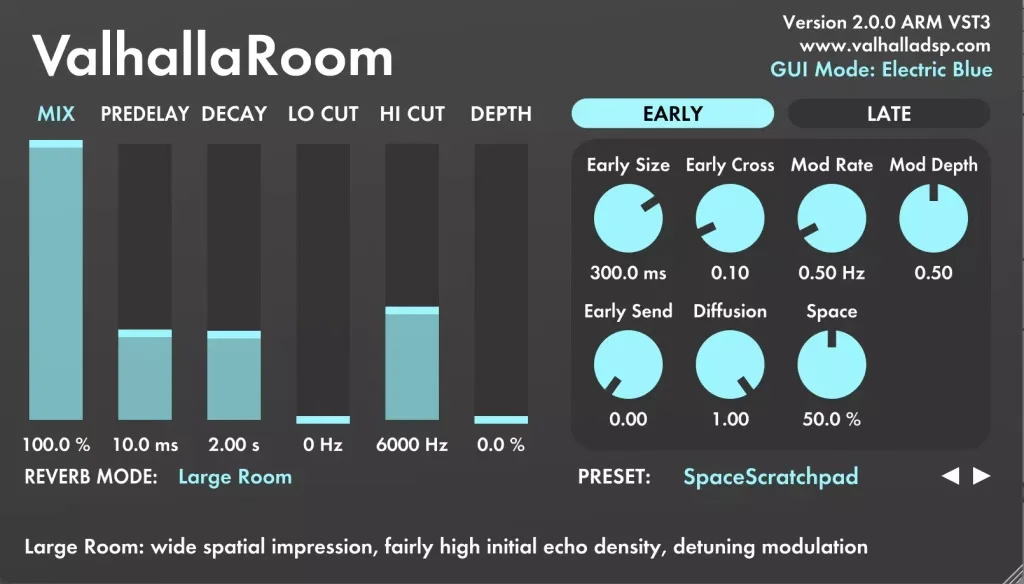
10. Valhalla Room:
This plugin needs no introduction; if you only buy one reverb, this is the safest choice. From artists such as Martin Garrix, Tame Impala, Tycho, and a lot more. This is one of the most used reverb plugins around the world. It is a true-stereo algorithmic reverb with twelve original modes for natural rooms, halls, and dark spaces, with free lifetime updates and no iLok or subscription. Valhalla Room is a very easy-to-use plugin, even the most recommended plugin from this list. The best part is it dates back to 2011 and still holds up. But keep in mind that it leans clean and natural rather than vintage, so it’s not the pick if you want gritty character.
Best for: drums, vocals, and acoustic instruments.
11. TAL-Reverb-2 (FREE):
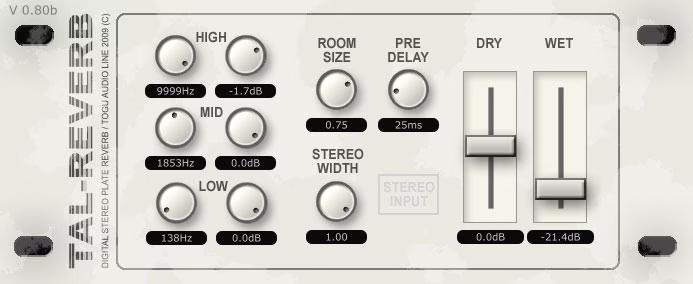
A free plugin on this list, TAL-Reverb-2 comes with adjustable room size and decay, up to 1000 ms of pre-delay, a subtractive three-band EQ, stereo width, mono or stereo input, and ten presets. It is one of the best reverb plugins for beginners. Firstly, you can use it on vocals, drums, and guitars, and secondly, it has a few controls, so easy to use. That makes this one of the best free reverb plugins of 2026.
Which one should you buy?
Honestly, It depends on your budget and usage, but If you want one reverb for everything, Valhalla Room is the pick on a budget, and FabFilter Pro-R 2 is the one to choose if you want more control. For vocals, you can try BB Chamber D or SuperPlate, or TAL-Reverb-2 if you want a free plate. Lexicon 224 is the one for that ’80s sound, and it also suits drums and snare, along with Valhalla Room. Crystalline adds polish to pop and electronic tracks, while Blackhole and Hyperspace are better for ambient music and sound design. If you’d like spring, plate, and hall in a single plugin, Dimensions covers all three and lastly, the Renaissance Reverb is a good choice if you want a familiar, classic mix reverb.